June 26, 2026
How to Choose the Right Stainless Steel Enclosure for Industrial Use
Introduction
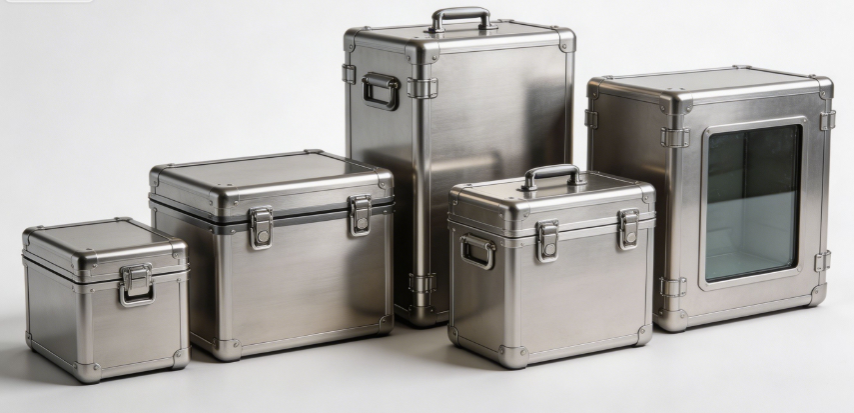
Stainless steel enclosures are essential protective housings for industrial electrical, electronic, and automation equipment. Unlike ordinary carbon steel or plastic casings, they feature outstanding corrosion resistance, mechanical rigidity, dustproof and waterproof performance, and long service life, adapting to harsh factory, outdoor, coastal, and chemical working environments.
Many industrial purchasers and engineers face incorrect selection problems, such as choosing the wrong stainless steel grade, insufficient protection level, or unreasonable wall thickness, resulting in rusting, water ingress, equipment short circuits, and frequent replacement losses. This article systematically introduces professional and practical industrial stainless steel enclosure selection methods to help users match the most suitable product according to actual working conditions.
1. Select Appropriate Stainless Steel Grade by Working Environment
The material grade is the core factor determining the enclosure’s durability and corrosion resistance. Industrial stainless steel enclosures are mainly divided into 201, 304, and 316 grades, each with distinct environmental adaptability.
201 Stainless Steel: It has low cost and basic anti-rust ability but poor resistance to acid, alkali, and salt spray. It is only suitable for dry indoor industrial environments with low dust and no corrosive gas. It is not recommended for outdoor, coastal, and chemical factory scenarios, as it is prone to surface rust and oxidation after long-term use.
304 Stainless Steel: As the most versatile industrial grade, it contains stable chromium and nickel components, providing excellent resistance to atmospheric corrosion, common moisture, and weak acid and alkali erosion. It adapts to most indoor workshops, ordinary outdoor environments, mechanical equipment supporting, and conventional electrical distribution control scenarios, achieving balanced performance and cost.
316 Stainless Steel: Added with 2%–3% molybdenum element, it greatly enhances resistance to chloride, salt spray, and strong chemical corrosion. It is the preferred material for coastal salt fog environments, chemical plants, sewage treatment, marine equipment, and high-humidity corrosive workshops. It effectively avoids pitting corrosion and gap corrosion that easily occur in 304 steel in harsh environments.
2. Confirm Industrial-Grade IP Protection Rating
The IP rating defines the enclosure’s dustproof and waterproof capability, which directly determines equipment safety in complex industrial scenarios. Ordinary civilian enclosures cannot meet industrial production standards, so targeted IP level selection is required based on on-site dust and humidity conditions.
For dry indoor industrial workshops with less dust, IP54 is sufficient to prevent conventional dust intrusion and splashing water. For general outdoor equipment, production lines, and humid processing workshops, IP65 is the mainstream industrial standard, achieving full dust prevention and resistance to high-pressure water jet flushing. For fully open coastal, rain-intensive, and severe wet environments,IP66 or above is required to ensure long-term stable operation of internal electrical components.
3. Reasonable Wall Thickness Selection for Mechanical Rigidity
Enclosure wall thickness determines structural rigidity, impact resistance, and deformation resistance. Thin-walled stainless steel casings are prone to dents and deformation under external collision, vibration, and long-term load, affecting internal component installation and overall sealing performance.
Conventional indoor light-load industrial enclosures adopt 1.2mm–1.5mm thickness, meeting daily protection and assembly needs. For outdoor equipment, frequently vibrating production lines, and mechanical supporting scenarios, 1.5mm–2.0mm thick plates are recommended to improve impact resistance and structural stability. Heavy-duty industrial enclosures for mechanical equipment bases and high-shock environments need a thickness of more than 2.0mm to maintain long-term non-deformation performance.
4. Match Size and Structural Design Requirements
A reasonable size reservation facilitates internal wiring, heat dissipation, and later maintenance. The internal space should reserve 20%–30% redundant space on the basis of accommodating electrical components, avoiding component crowding that causes poor heat dissipation and accelerated aging.
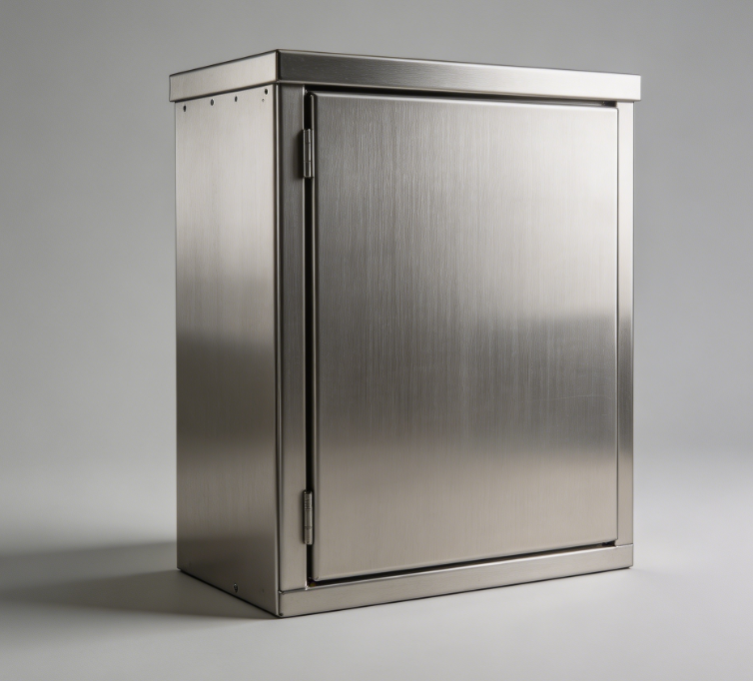
For heat-generating equipment such as inverters and power modules, select enclosures with reserved heat dissipation holes, fan installation positions, or heat dissipation grooves. For frequently operated equipment, prefer door-opening structures with waterproof sealing strips and hidden hinges to ensure convenient operation while maintaining tightness. For multi-circuit control equipment, choose enclosures with separable internal installation guide rails and layered structural design.
5. Standard Surface Treatment and Craft Inspection
High-quality industrial stainless steel enclosures adopt fine wire drawing and passivation treatment processes. The surface is smooth and uniform without burrs, scratches, or welding gaps. Welded parts are fully sealed to prevent moisture and dust from penetrating through gaps.
Qualified products have uniform sealing rubber strips, tight door gaps, stable opening and closing, and standardized thread holes. Inferior enclosures have rough welding, uneven surfaces, and aging-prone accessories, which will reduce the overall protection performance and service life.
6. Select Special Functions for Special Scenarios
For flammable and explosive industrial environments such as chemical and petroleum industries, select explosion-proof stainless steel enclosures with professional certification to avoid explosion risks caused by electrical sparks. For low-temperature outdoor environments, choose low-temperature resistant reinforced structures to prevent material embrittlement. For high-dust production workshops, configure dust-proof breathable valves to balance internal and external air pressure while blocking dust.
Stainless Steel Enclosure Selection Comparison Table
Selection Item | 201 Stainless Steel | 304 Stainless Steel | 316 Stainless Steel |
Corrosion Resistance | Weak, easy to rust in humid air | Excellent, anti-rust and anti-oxidation | Superior, salt spray and chemical resistant |
Applicable Environment | Dry indoor ordinary workshop | Most indoor and outdoor general industrial scenarios | Coastal, chemical, sewage, corrosive environment |
IP Matching Level | IP54 for indoor use only | IP54/IP65 universal for industrial use | IP65/IP66 for harsh environments |
Cost Performance | Low cost, limited service life | High cost performance, first choice for standard industry | High cost, professional harsh environment dedicated |
Common Selection Mistakes to Avoid
Many enterprises blindly pursue low cost and choose 201 stainless steel for outdoor and corrosive environments, resulting in rapid rust and equipment failure. Some users excessively select 316 stainless steel for ordinary indoor scenarios, causing unnecessary cost waste. In addition, ignoring wall thickness and only focusing on materials leads to insufficient structural rigidity and easy deformation of the enclosure.
The correct selection logic is to match materials, protection levels, and thicknesses according to the actual environment, realizing the balance of safety, stability, and cost.
Conclusion
Choosing a suitable industrial stainless steel enclosure needs to comprehensively consider material grade, IP protection rating, wall thickness, structural design, and scenario-based special functions. 304 stainless steel with IP65 protection is the most universal and cost-effective solution for most industrial scenarios, while coastal and chemical corrosive environments must choose 316 stainless steel with higher corrosion resistance.
Scientific selection effectively protects internal electrical and automation equipment, reduces failure rates and maintenance costs, and ensures long-term stable and safe operation of industrial production systems.