October 15, 2026
How to Select an Explosion-Proof Junction Box
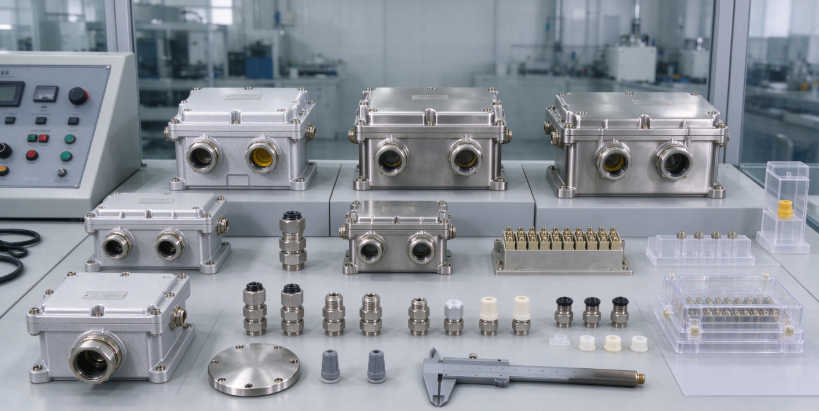
Table of Contents
· Why an explosion-proof junction box needs application-based selection
· 1. Start with the hazardous-area classification
· 2. Check enclosure construction and materials
· 3. Plan cable entries, terminals and sealing
· 4. Review installation, inspection and maintenance
· Illustrative project scenario
· Frequently Asked Questions
· Conclusion
· TDK
Selecting an explosion-proof junction box requires more than checking a metal enclosure’s dimensions. The box must suit the hazardous-area classification, internal circuit, cable system, corrosion environment and inspection routine. This guide uses the product directions visible on Shanghai Xiaohong’s website while avoiding unverified model numbers, ratings or certificates.
Why an explosion-proof junction box needs application-based selection
An explosion-proof junction box is not selected by appearance alone. It forms part of an electrical installation in an environment where flammable gas, vapor, dust or fibers may be present. The enclosure, cable entries, terminals, cover interface, fasteners and installation method must work as one controlled system.
Shanghai Xiaohong’s website presents Explosion-Proof Boxes, explosion-proof enclosures and weatherproof electrical boxes for industrial applications. It also references hazardous environments and Zone 1 and Zone 2 products. The exact protection concept, certificate scope and available construction should be confirmed for the project rather than assumed from a general product label.
1. Start with the hazardous-area classification
Before requesting a quote, provide the hazardous-area classification, gas or dust group where applicable, temperature class or surface-temperature requirement, ambient temperature, installation location and required ingress protection. These inputs determine which enclosure and cable-entry arrangements can be considered.
Explain what the junction box must contain: terminal blocks, earthing points, barriers, fuses, relays, sensors or simple cable joints. Identify voltage, current, conductor size, number of circuits and spare ways. A box with insufficient working space creates installation and inspection problems even when the enclosure itself is suitable.
Long-tail searches such as explosion-proof junction box for hazardous areas, Zone 1 electrical junction box and industrial Ex junction box manufacturer reflect different procurement intent. Use them naturally, but keep the technical specification primary.
2. Check enclosure construction and materials
Review body material, wall thickness, cover design, gasket or flamepath concept, fasteners, hinges, drain or breather arrangements and surface finish. Stainless steel, coated steel, aluminum or other materials may suit different corrosion and mechanical environments; selection should follow the site conditions and certified design.
Outdoor and chemical-processing locations require attention to corrosion, UV exposure, water, salt, cleaning chemicals and impact. A weatherproof claim does not automatically establish explosion protection, and explosion protection does not automatically solve every outdoor corrosion problem.
Ask for dimensional drawings showing mounting holes, usable internal space, cover clearance and cable-entry zones. Confirm whether modifications, drilling or painting are permitted without affecting the approved protection concept.
3. Plan cable entries, terminals and sealing
Cable glands, conduit hubs, stopping plugs and blanking elements must match the enclosure, cable type, thread standard and protection method. Check entry direction, bend radius, sealing range, armor termination and spare entries before fabrication.
Terminal selection should consider conductor size, temperature, creepage, clearance, vibration and maintenance access. Label each circuit and reserve space for inspection. Mixing unrelated circuits may make future troubleshooting harder.
Sealing is part of the installation, not a cosmetic detail. Confirm gasket condition, gland tightening, plug selection and the method for maintaining protection after a cable is replaced.
4. Review installation, inspection and maintenance
The installation drawing should show mounting orientation, cable routing, bonding or earthing, torque requirements and access clearance. Operators should not open the enclosure unless the site procedure confirms that it is safe to do so.
Create an inspection routine for cover fasteners, cable glands, corrosion, labels, earth continuity and signs of impact. Maintenance personnel need the certificate documents, spare-part references and instructions for restoring the original protection after service.
Xiaohong’s public page describes explosion-proof boxes, outdoor enclosures and custom metal fabrication. Project-specific certification, dimensions, materials and modification limits should be written into the quotation.
Illustrative project scenario
A chemical-processing site needs a junction box for field instruments in a classified area. The engineering team supplies the area classification, cable schedule, ambient conditions and terminal count. The supplier reviews entry locations, internal space and installation access before a drawing approval and inspection plan. This is illustrative, not a reported Xiaohong customer case.
Frequently Asked Questions
What information is needed for an explosion-proof junction box quote?
Provide area classification, gas or dust conditions, ambient temperature, ingress requirement, circuits, cable data, terminals, material preference, dimensions and installation method.
Is a weatherproof box the same as an explosion-proof box?
No. Weather protection and explosion protection address different risks. Confirm the required protection concept and certificate scope.
Can I drill extra cable entries after delivery?
Do not assume this is permitted. Unauthorized modification may affect the approved protection concept. Confirm the manufacturer’s allowed modification process.
Why are cable glands important?
They maintain sealing, strain relief and the intended protection at every cable entry. Their type and installation must match the enclosure and cable.
Conclusion
A suitable explosion-proof junction box is the result of coordinated area classification, enclosure design, cable entries, terminals and installation controls. Confirm every project-specific requirement in the drawing, certificate documents and technical quotation before purchase.