July 14, 2026
Sheet Metal Fabrication Insights: How to Identify Premium Stainless Steel Enclosures Through Welding, Grinding, and Packaging
Introduction
Stainless steel enclosures protect critical electrical and electronic equipment in some of the most demanding environments—chemical plants, coastal facilities, food processing lines, marine installations, and outdoor applications exposed to moisture, salt spray, and corrosive contaminants. The material specification alone—304 or 316 stainless steel—is insufficient to determine performance. The difference between an enclosure that lasts twenty years and one that fails in five often comes down to three factors that are visible to the trained eye: welding quality, grinding and surface finishing, and packaging integrity.
These three elements reveal whether a manufacturer is cutting corners or delivering precision-engineered products. This guide examines each stage in detail, providing practical criteria for identifying premium stainless steel enclosures through what you can see, touch, and verify.
Part One: Welding — The Foundation of Structural Integrity
Welding is the most critical phase in stainless steel enclosure fabrication. It determines structural strength, dimensional stability, corrosion resistance, and long-term reliability. A poorly welded enclosure may look acceptable on the surface but will fail under thermal cycling, vibration, or mechanical stress.
What to Look For
Continuous, uniform weld beads. Premium enclosures feature welds that are continuous, uniform, and free from defects. Acceptable welds should show no signs of cold lap, porosity, or undercut. Cold lap occurs when the weld metal fails to fuse properly with the base material, creating a hidden crack that compromises structural integrity. Porosity—small gas pockets trapped in the weld—weakens the joint and creates pathways for corrosive agents. Undercut—a groove melted into the base metal adjacent to the weld—reduces the effective thickness and creates stress concentration points.
Weld penetration meets requirements. For structural integrity, weld penetration should reach at least 80% of the base material thickness. Shallow penetration indicates insufficient heat input or improper technique, resulting in weak joints that may fail under load. Full penetration welds, where the weld metal extends through the entire joint thickness, provide maximum strength and are essential for load-bearing applications.
No weld defects. Reject any enclosure with visible weld defects. Common defects to watch for include:
Cracking. Weld cracks—whether in the weld metal, heat-affected zone, or base metal—are unacceptable. Cracks propagate under stress and lead to catastrophic failure.
Weld spatter. Excessive spatter indicates poor parameter control and suggests a lack of attention to detail.
Burn-through. Excessive heat that melts completely through the material creates holes and weakens the joint.
Incomplete fusion. When weld metal fails to fuse with the base material or previous weld passes, the joint lacks structural continuity.
Slag inclusions. Non-metallic material trapped in the weld creates weak points and corrosion initiation sites.
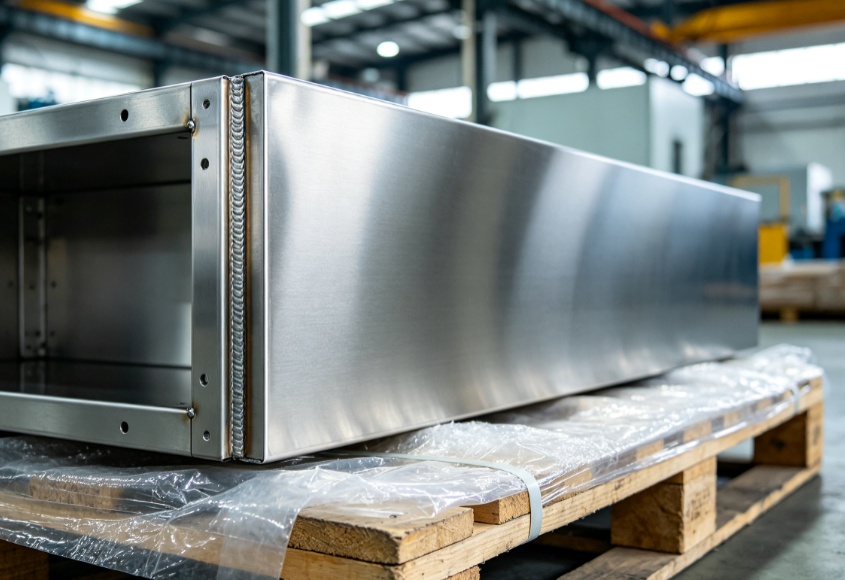
Weld seam surface quality. On exterior surfaces, weld seams should be ground smooth and flush with the surrounding material. Visible weld beads on exposed surfaces are acceptable only where specified by design. The weld seam should transition smoothly into the base material without sharp edges or undercuts. Surface ripple on the weld bead should be less than 1mm in height.
Consistency across the enclosure. Compare weld quality across all seams. A manufacturer that takes care on visible seams but cuts corners on hidden seams is likely cutting corners elsewhere. Premium enclosures maintain consistent quality on all welded surfaces—front, back, top, bottom, and internal structures.
Welding process control. High-quality stainless steel enclosures are typically welded using Gas Tungsten Arc Welding (GTAW/TIG) or pulse MIG welding with matching filler metal. TIG welding provides superior control over heat input and weld quality, producing cleaner, more precise welds. Pulse MIG welding reduces heat input and distortion while maintaining high deposition rates.
Distortion control. Stainless steel has a higher coefficient of thermal expansion than carbon steel, making it more susceptible to welding distortion. Angular distortion and wavy deformation are common issues. Premium manufacturers control distortion through proper fixturing, balanced welding sequences, and appropriate heat input management. Check enclosure corners and long seams for flatness and squareness—visible distortion indicates inadequate process control.
The Difference Between Premium and Standard
Standard-grade enclosures often feature welds that are adequate but not exceptional—they may show minor spatter, slight undercut, or inconsistent bead profiles. Premium enclosures exhibit welds that are visually consistent, free from defects, and ground smooth to match the surrounding finish. A premium manufacturer treats every weld as a quality statement.
Standards Reference
ISO 5817 provides weld quality levels for fusion-welded steel joints.
AWS D1.6/D1.6M is the structural welding code for stainless steel assemblies.
BS EN 1011-3 provides general recommendations for fusion welding of stainless steels.
Part Two: Grinding and Surface Finishing — The Mark of Craftsmanship
Grinding and surface finishing transform a functional welded structure into a finished product that reflects the manufacturer’s commitment to quality. The visible surface of an enclosure tells a story about the care taken during fabrication.
What to Look For
A three-stage grinding process. Quality stainless steel grinding follows a systematic progression: rough grinding → semi-finishing → finishing. Rough grinding removes weld reinforcement and levels the surface. Semi-finishing refines the surface and removes scratches from the rough grinding stage. Finishing achieves the final specified surface texture and appearance. Premium manufacturers complete all three stages—they do not skip steps to save time.
Consistent grain direction. On brushed or satin finishes, the grain lines should be uniform, parallel, and consistent across the entire surface. Grain direction should be consistent across all visible surfaces of the enclosure. Mismatched grain direction on adjacent panels indicates poor planning or insufficient quality control.
Smooth transitions. At welded joints, the transition from weld to base material should be smooth and imperceptible. There should be no visible weld bead, no sharp step, and no sudden change in surface texture. Running a fingertip across the weld area should reveal no discernible edge or ridge. Welds should be ground smooth, with no sharp corners or weld beads protruding.
Absence of surface defects. The finished surface should be free from:
Scratches and gouges. Deep scratches compromise corrosion resistance by creating crevices where corrosive agents can accumulate.
Pitting or pockmarks. Surface irregularities indicate poor material quality or inadequate finishing.
Discoloration or heat tint. Heat tint—blue, gold, or brown discoloration near welds—indicates excessive heat input and can reduce corrosion resistance. Premium manufacturers remove heat tint through pickling or mechanical finishing.
Sanding marks. Visible sanding marks or swirl patterns indicate rushed or incomplete finishing.
Uniform surface texture. Run your hand across the surface. It should feel consistently smooth without rough patches, raised weld seams, or depressions. Surface flatness should be consistent—no wavy reflections or “funhouse mirror” distortion.
Ra surface roughness. Surface roughness is measured in Ra (arithmetic average roughness). Premium stainless steel enclosures achieve surface finishes of Ra 0.4 μm or better. Standard commercial finishes typically range from Ra 0.8 to 1.6 μm. A finer surface finish provides better corrosion resistance and easier cleaning.
Edge treatment. All edges should be deburred and smooth. Sharp edges indicate rushed finishing and potential safety hazards. Corners should be radiused appropriately—not left sharp or unfinished.
The Difference Between Premium and Standard
Standard-grade enclosures often show visible grinding marks, inconsistent grain patterns, or slight surface irregularities. The grinding may be adequate but not refined. Premium enclosures exhibit surfaces that are visually and tactilely consistent—grain lines flow uniformly, transitions are imperceptible, and the finish reflects light evenly across all surfaces.
Performance Implications
Surface finish is not merely aesthetic. A smooth, non-porous surface is less likely to harbor contaminants and easier to clean. In hygienic applications—food processing, pharmaceutical manufacturing, medical facilities—surface finish directly affects cleanliness and regulatory compliance. In corrosive environments, a polished surface provides fewer sites for corrosion initiation.
Part Three: Packaging — The Final Quality Signal
Packaging is often overlooked as a quality indicator, but it reveals a manufacturer‘s commitment to delivering products in the condition they were made. Premium enclosures deserve premium packaging.
What to Look For
Appropriate packaging materials. Premium enclosures are packaged with materials that provide protection against the hazards of shipping and handling:
Stretch film or shrink wrap to protect against moisture and dust during transit.
Foam padding (PE foam, EPE foam, or similar) to cushion against impacts.
Edge protectors on corners and vulnerable edges.
Cardboard or wooden crates for structural protection during shipping. Wooden crates provide superior protection for large or heavy enclosures.
Cushioning and blocking. Inside the package, the enclosure should be immobilized with adequate cushioning. It should not shift or move when the package is handled. Cushioning materials should be positioned to prevent direct contact between the enclosure and the outer packaging, which could transfer impact forces during shipping.
Moisture protection. For shipments subject to moisture exposure—ocean freight, humid climates, or extended storage—packaging should include vapor barriers, desiccants, or VCI (vapor corrosion inhibitor) materials. Stainless steel is corrosion-resistant, but surface contamination and trapped moisture can cause staining or pitting during long transit times.
Cleanliness. The enclosure should be clean before packaging—free from dust, debris, fingerprints, and processing residues. Packaging that appears rushed or careless suggests that the manufacturer treats the product with similar carelessness. Look for protective film on the exterior surfaces during shipment to prevent scratching.
Customization. Premium manufacturers often provide custom packaging designed for the specific enclosure dimensions and weight. Standardized packaging that is visibly oversized or under-protected indicates a one-size-fits-all approach that compromises protection.
Documentation and labeling. Packaging should include proper labeling: handling instructions (“Fragile,” “This Side Up”), product identification, and relevant certifications. A well-labeled package reflects an organized and professional operation.
The Difference Between Premium and Standard
Standard-grade packaging provides basic protection—enough to get the product to the destination without catastrophic damage, but often with minor scratches, dents, or surface marks. Premium packaging delivers the enclosure in the same condition it left the factory—clean, undamaged, and ready for installation.
A Real-World Example
One manufacturer has implemented a dual-protection system using “honeycomb board + air column bag” packaging to protect stainless steel enclosures during long-distance transport. This combination provides both structural rigidity and impact absorption—a level of care that signals a commitment to product quality. Before shipment, the manufacturer uses 3D scanning technology for full dimensional inspection, verifying that each enclosure matches drawings within 0.1mm tolerance.
How to Verify Quality: A Practical Checklist
Inspection Point | What to Look For | Red Flag |
Weld continuity | Continuous, uniform beads | Stops, starts, or gaps in welds |
Weld defects | No cracks, porosity, undercut, or spatter | Any visible defects |
Weld penetration | Full penetration; ≥80% of material thickness | Shallow, incomplete penetration |
Weld finish | Ground smooth; transitions flush with base metal | Visible beads, sharp edges, or ridges |
Surface grain | Uniform, parallel, consistent direction | Swirl marks, inconsistent grain, mismatched panels |
Surface defects | No scratches, pits, discoloration, or sanding marks | Any visible surface defects |
Surface roughness | Ra ≤0.8 μm (premium: Ra ≤0.4 μm) | Visible roughness or texture variations |
Edge treatment | Deburred, smooth, appropriately radiused | Sharp edges or burrs |
Packaging | Custom-fit, cushioned, clean | Loose fit, minimal cushioning, dirty |
Moisture protection | Vapor barrier, desiccant, or VCI as needed | None provided for sensitive shipments |
Documentation | Complete, professional labeling | Incomplete or missing documentation |
Conclusion
Premium stainless steel enclosures are distinguished not by a single feature but by the cumulative evidence of quality across welding, grinding, and packaging. Each stage reveals something about the manufacturer‘s capabilities and commitment.
Welding reveals structural integrity—whether the enclosure will withstand thermal cycling, vibration, and mechanical stress over its service life. Inspect for continuous, defect-free welds with proper penetration and smooth finishing.
Grinding and surface finishing reveal craftsmanship—whether the manufacturer takes pride in the product’s appearance and corrosion resistance. Inspect for uniform grain patterns, smooth transitions, and absence of surface defects.
Packaging reveals respect for the product—whether the manufacturer treats each enclosure as a finished product worthy of protection. Inspect for appropriate cushioning, moisture protection, and cleanliness.
A manufacturer that excels in all three areas is a manufacturer that understands that quality is not a single step—it is a discipline applied at every stage of production. When specifying stainless steel enclosures, look beyond the material grade. Look at the welds, the finish, and the packaging. They will tell you everything you need to know.