August 11, 2026
Surging Demand of Sanitary Stainless Steel Electrical Enclosure In Global Food & Offshore Wind Industry
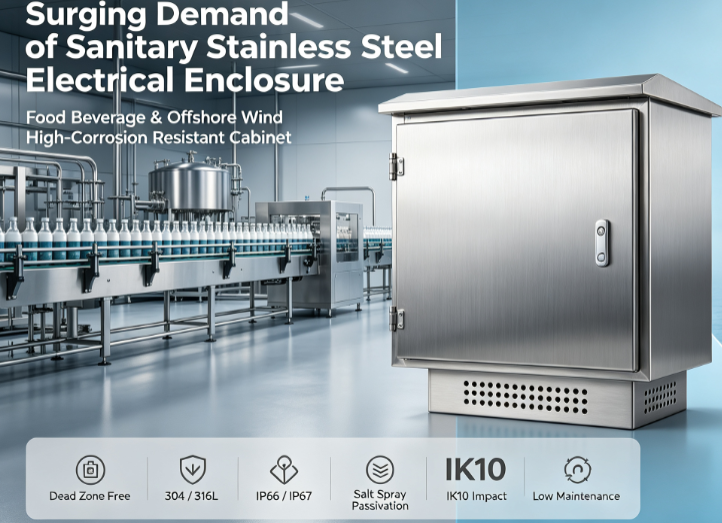
Table of Contents
1. Global Market Boom: Fast Rising Demand of Sanitary Stainless Steel Electrical Enclosure (Verified Industry Data)
2. Two Core Downstream Verticals Driving Mass Order Growth 2.1 Food & Beverage Industry: Strict Sanitation & Wash-Down Compliance Rules Push Replacement Wave 2.2 Offshore Wind Energy: C5-M Extreme Marine Corrosion Environment Mandate Marine-Grade Sanitary Cabinets
3. Unique Harsh Environmental Risks For Electrical Cabinets In Food Factories & Offshore Wind Sites
4. 6 Core Standard Performance Indicators For Qualified Sanitary Stainless Steel Electrical Enclosure 4.1 Full Hygienic Dead-Corner-Free Design To Meet FDA & EHEDG Sanitation Rules 4.2 Multi-Grade Stainless Steel Material Anti-Corrosion Matching (304 / 316L Marine Version) 4.3 IP66 / IP67 High Ingress Protection For High-Pressure Wash & Sea Salt Mist Blocking 4.4 Long Salt Spray Endurance & Anti-Discoloration Surface Passivation Treatment 4.5 High Mechanical Impact Resistance IK10 Standard For Workshop & Offshore Vibration 4.6 Self-Draining Structure & Low Long-Term Maintenance Whole Lifecycle Cost
5. Performance Comparison: Sanitary Stainless Steel Enclosure VS Mild Steel / Plastic Electrical Cabinet
6. Standard Production & Surface Treatment Process To Reach Sanitary & Anti-Corrosion Benchmarks
7. Main Application Scenarios In Food Processing Plants & Offshore Wind Farms
8. Step-by-Step Material & Grade Selection Guide For Food OEM & Wind EPC Contractors
9. Industry FAQ For Sanitary Stainless Steel Electrical Enclosure Sourcing & Operation
1. Global Market Boom: Fast Rising Demand of Sanitary Stainless Steel Electrical Enclosure (Verified Industry Data)
The whole stainless steel electrical cabinet global market hit USD 2.4 billion in 2025, predicted to expand at 6.3% CAGR up to USD 3.7 billion in 2033, per PW Consulting’s 2026 full industrial report. Sanitary stainless steel enclosure is the fastest-growing subdivision, powered by food automation upgrade and offshore wind global capacity expansion.
From material breakdown data in 2025, grade 304 stainless steel takes 64.14% market share (USD 1,539.32 million), while marine sanitary 316L stainless steel holds 30.10% share (USD 722.48 million). Food & beverage sector contributes 29.84% total revenue of stainless steel electrical enclosure market, valued at USD 716.19 million in 2025, ranking the largest single downstream industry. Renewable energy (offshore wind + utility solar) accounts for 28.7% metallic enclosure global demand, with 6.4% annual growth till 2033, Dataintelo data records.
Asia Pacific dominates regional shipment share at 41%, China’s offshore wind construction and domestic food intelligent production line renovation create huge incremental orders. Europe follows with 27% share, driven by strict EU food hygiene regulation and North Sea offshore wind farm mass deployment.
Many plant operators and wind developers phase out painted mild steel and plastic cabinets. The key driver is sanitary stainless steel enclosure balances full wash-down hygiene, long-term salt fog corrosion resistance and low downtime loss, cutting total operation cost by 32% over 10-year service cycle.
2. Two Core Downstream Verticals Driving Mass Order Growth
2.1 Food & Beverage Industry: Strict Sanitation & Wash-Down Compliance Rules Push Replacement Wave
Global food automation penetration rises 15% year by year, FDA, EHEDG and EU 1935/2004 hygiene standards enforce regular high-pressure hot water, alkaline detergent and chlorine disinfectant full wash for all production line equipment. Ordinary painted steel cabinets peel coating after dozens of wash cycles, plastic boxes crack under repeated chemical erosion, both will trigger cross-contamination risk and factory inspection failure. Sanitary stainless steel electrical enclosure with seamless arc design becomes mandatory standard for filling, baking, meat processing and dairy workshop control boxes. QYResearch survey shows over 60,000 new food factories globally built in 2025 all adopt stainless sanitary electrical cabinets as standard configuration.
2.2 Offshore Wind Energy: C5-M Extreme Marine Corrosion Environment Mandate Marine-Grade Sanitary Cabinets
Global offshore wind newly installed capacity will break 380 GW from 2026 to 2034, per GWEC industry forecast. More projects shift from nearshore shallow water to far-offshore deep sea, falling into ISO 12944 CX extreme corrosion grade. Nacelle control boxes, offshore booster station electrical distribution cabinets and wind tower bottom PLC enclosures run 24/7 exposed to sea salt mist, strong UV and cyclic temperature swing from -35℃ to +60℃. Common coated steel cabinets only survive 2–3 years offshore, while 316L sanitary stainless steel enclosure reaches 20-year design lifespan matching wind turbine full cycle. In 2025, offshore wind takes 9.1% growth rate of sanitary stainless steel enclosure market, the highest among all energy segments.
3. Unique Harsh Environmental Risks For Electrical Cabinets In Food Factories & Offshore Wind Sites
Food Processing Plant Working Hazards
1. Recurring high-pressure hot water wash with chlorine, hydrogen peroxide and alkaline cleaning agents; chemical residues stay inside cabinet gaps to cause local corrosion
2. Humid constant-temperature workshop (40–70% RH), food grease and protein residue breed mold if cabinet surface has dead corners
3. Frequent trolley collision, mechanical impact from packaging and cutting equipment, scratch weakens surface protective film
Offshore Wind Farm Marine Hazards
1. High-concentration chloride salt fog, wind gust carry NaCl particles to form electrochemical pitting corrosion
2. Long-time UV radiation at sea, normal coating powder and crack within 150h outdoor exposure
3. Day-night & seasonal temperature alternation leads to internal cabinet condensation, short-circuit risk for sensitive electrical components
4. Continuous vibration from turbine operation loosens cheap cabinet welds and sealing strips
4. 6 Core Standard Performance Indicators For Qualified Sanitary Stainless Steel Electrical Enclosure
4.1 Full Hygienic Dead-Corner-Free Design To Meet FDA & EHEDG Sanitation Rules
Qualified sanitary cabinet adopts full R≥3mm arc transition for all internal corners, seamless full weld without narrow crevices to trap grease and disinfectant residue. External top surface with built-in inclined self-drain slope, no standing liquid after high-pressure wash. No protruding screw heads on outer surface; all fasteners hidden inside to comply with EHEDG hygienic machinery standard, cross-contamination risk eliminated.
4.2 Multi-Grade Stainless Steel Material Anti-Corrosion Matching (304 / 316L Marine Version)
Two mainstream material grades for different application scenarios, tested under ISO 9227 salt spray standard:
1. Grade 304 sanitary stainless steel: ≥300h neutral salt spray without rust spot, fit inland food processing workshops with mild disinfection frequency
2. Marine dedicated 316L low-carbon stainless steel (316L): molybdenum element added, pass 500h salt spray test, resist high chloride offshore salt mist and high-concentration food disinfectant long-term erosion. Carbon content controlled ≤0.03% for 316L version to avoid weld intergranular corrosion after long temperature cycle.
4.3 IP66 / IP67 High Ingress Protection For High-Pressure Wash & Sea Salt Mist Blocking
Full cabinet adopts one-piece silicone foam double sealing strip, meet IEC 60529 IP66 / IP67 ingress protection level. IP66: fully dust-tight, resist high-pressure water jet from any direction, suitable for food daily wash-down; IP67: temporary 1m deep water immersion resistant, selected for offshore wind booster station splash zone cabinets. Ordinary mild steel cabinets only reach IP54, can not block fine salt mist particles penetrating cabinet interior.
4.4 Long Salt Spray Endurance & Anti-Discoloration Surface Passivation Treatment
Sanitary stainless steel enclosure must go through full pickling passivation after welding, plus electrolytic micro-brush finishing. A continuous dense chromium oxide passive film forms on surface, avoid black discoloration after thousands of disinfection wiping cycles or long sea wind exposure. Unpassivated stainless steel cabinet weld lines turn dark rust within 3 months under food chlorine wash or offshore salt fog environment.
4.5 High Mechanical Impact Resistance IK10 Standard For Workshop & Offshore Vibration
Whole cabinet structural performance follows IEC 62262 IK10 mechanical impact test standard: 2kg steel ball free drop impact without permanent dent, weld crack or sealing strip detachment. Thickness standard: food cabinet minimum 1.0mm stainless plate, offshore wind heavy-duty cabinet 1.5–2.0mm plate to resist offshore vibration and typhoon wind load impact.
4.6 Self-Draining Structure & Low Long-Term Maintenance Whole Lifecycle Cost
Built-in self-drain hole at cabinet bottom, condensed water and wash liquid automatically flow out without staying inside cavity. Fully sealed integrated assembly, zero regular re-coating or rust removal maintenance required in 10–20 year service life. Plastic and painted steel cabinets need annual surface repair and sealing strip replacement, raising recurring maintenance labor cost significantly.
5. Performance Comparison: Sanitary Stainless Steel Enclosure VS Mild Steel / Plastic Electrical Cabinet
表格
Test & Application Index | Sanitary Passivated Stainless Steel Enclosure (304/316L) | Painted Mild Steel Electrical Cabinet | PP Plastic Cabinet | End-User Operational Impact |
Salt Spray Resistance | 304 ≥300h; 316L ≥500h no pitting rust | Only 80–120h coating peel & rust | 120h surface crack & embrittle | Mild/plastic cabinets replace every 2–3 years |
Sanitary Dead-Corner Design | Full arc seamless, EHEDG compliant | Sharp right-angle gaps trap dirt | Mold growth inside micro pores | Food plant inspection non-compliance risk |
Ingress Protection Grade | IP66 / IP67 double silicone seal | IP54 single rubber seal | IP65 thin plastic seal easy aging | Salt mist & wash water enter cabinet short circuit |
Mechanical Impact Standard | IK10 no deformation after heavy hit | IK06 dent easily | IK04 crack under trolley collision | Equipment cabinet damaged in daily operation |
Disinfectant Chemical Resistance | Resist chlorine, alkali, peroxide long-term wipe | Paint dissolved by disinfectant within 6 months | Plasticizer precipitate after frequent wash | Food raw material cross-contamination hidden danger |
Design Service Lifespan | Food 10 years; offshore wind 20 years | 2–4 years | 1–3 years | Stainless steel cuts whole lifecycle cost over 45% |
Data reference: ISO 9227 salt spray test comparative report & IEC 60529 ingress protection standard test data.
6. Standard Production & Surface Treatment Process To Reach Sanitary & Anti-Corrosion Benchmarks
1. Stainless steel sheet laser blanking, deburring & full R arc CNC bending, eliminate sharp stress edges
2. Fiber laser seamless full welding, zero narrow joint gaps; all welds ground smooth flush with base plate
3. Whole cabinet full immersion pickling passivation tank, rebuild uniform anti-corrosion passive film on weld heat affected zone
4. Mechanical micro-brush uniform surface finishing, no messy scratch texture, easy to wipe clean
5. Double silicone sealing strip assembly, built-in self-drain trough and hidden fastener structure for sanitary demand
6. Batch sampling inspection: neutral salt spray test, IP water spray test, IK10 impact test, EHEDG sanitary structure audit before delivery
Skip passivation or seamless welding procedure, stainless steel enclosure will fail corrosion and hygiene indicators in short-term use.
7. Main Application Scenarios In Food Processing Plants & Offshore Wind Farms
Food & Beverage Industry Scenarios
1. Dairy, meat and baking production line PLC control cabinets, daily high-temperature detergent full wash
2. Bottling filling machine electrical junction boxes, touch screen operation enclosures
3. Cold storage workshop constant humidity electrical distribution cabinets, resist mold and water vapor corrosion
4. Food packaging robotic arm sanitary control boxes, comply with FDA food contact hygiene rules
Offshore Wind Energy Scenarios
1. Wind turbine nacelle internal frequency converter & monitoring system sanitary enclosures, resist offshore salt fog & UV
2. Offshore wind booster station high-low voltage electrical distribution cabinets, CX extreme marine corrosion environment
3. Wind tower bottom safety PLC control boxes, withstand long-time sea wind vibration and temperature alternation
4. Floating offshore wind platform auxiliary electrical cabinet, mandatory 316L marine stainless steel grade
8. Step-by-Step Material & Grade Selection Guide For Food OEM & Wind EPC Contractors
Step 1: Confirm application industry and environment corrosion grade (food inland mild / food high disinfection / nearshore wind / far-offshore CX wind) Step 2: Select material grade: inland food workshop pick 304 sanitary stainless steel; coastal food plant & all offshore wind projects adopt 316L low-carbon marine version Step 3: Confirm ingress protection demand: ordinary food line IP66; offshore splash zone cabinet upgrade to IP67 Step 4: Set cabinet plate thickness: general food cabinet 1.0mm; heavy-duty offshore wind cabinet 1.5–2.0mm for anti-vibration impact Step 5: Verify sanitary structure standard: full arc seamless, hidden fastener, self-drain design for food production line Step 6: Request factory salt spray test report and EHEDG / marine anti-corrosion certification before mass order
9. Industry FAQ For Sanitary Stainless Steel Electrical Enclosure Sourcing & Operation
Q1: What’s the core difference between sanitary stainless steel cabinet and ordinary industrial stainless electrical box?
A1. Ordinary industrial stainless box has sharp right-angle corners, exposed screws and incomplete weld treatment, only meet basic anti-rust demand. Sanitary version follows EHEDG and FDA hygiene rules, full seamless arc dead-corner-free design plus full passivation process, adapt to food high-pressure wash and offshore heavy salt mist two harsh working conditions at the same time.
Q2: Can grade 304 sanitary stainless steel cabinet be used for offshore far-offshore wind projects?
A2. Not recommended. 304 only reaches 300h salt spray standard, far-offshore deep sea belongs to ISO 12944 CX extreme corrosion grade with high chloride concentration, must choose molybdenum contained 316L stainless steel to hit 500h salt spray benchmark and 20-year service life.
Q3: Why passivation treatment is non-negotiable for qualified sanitary stainless steel enclosure?
A3. Welding high temperature destroys native chromium passive film on stainless steel surface, weld area becomes corrosion weak point without pickling passivation. Passivation rebuilds dense anti-corrosion film on whole cabinet surface, avoid weld blackening and pitting rust after long disinfection or marine exposure.
Q4: IP66 and IP67 which one to choose for food and offshore wind sites?
A4. Most indoor food processing production lines adopt IP66, fully block high-pressure wash water jet. Offshore wind booster station splash zone and floating wind platform cabinets select IP67 to resist temporary seawater immersion risk.
Q5: How long maintenance cycle of sanitary stainless steel electrical enclosure?
A5. Under standard matching material and environment, whole cabinet is maintenance-free within 10–20 years, no rust removal, re-paint or sealing strip replacement needed, greatly cut field maintenance labor expense compared with mild steel and plastic cabinets.